Legally compliant invoicing is more than a technical requirement in the freelance world; it is a form of self-protection that many freelancers do not realize they need until something goes wrong. When you work independently, you do not have a legal team behind you, you don’t have a corporate contract specialist reviewing every engagement, and you do not always have the luxury of drafting long, complex agreements. What you do have—consistently and reliably—is your invoice. For many freelancers across the globe, their invoice becomes the only written record of what was agreed upon, what was delivered, and how much compensation is due.
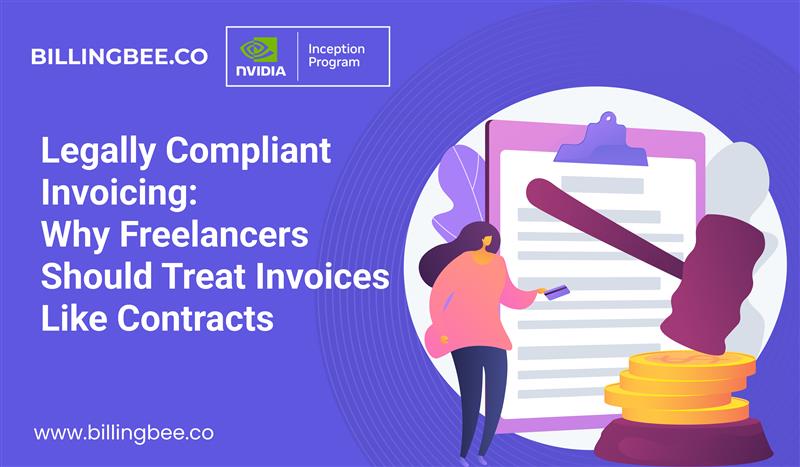
Yet most of us grow up thinking of invoices as simple payment requests. A document you send at the end of the work. A formality. But the truth is far different. In many countries and under many business regulations, a well-written invoice holds the same weight as a contract. It outlines your deliverables, confirms the client’s acceptance of your work, and records the terms under which you expect payment. In legal disputes, delayed payment situations, or tax reviews, your invoice is often treated as the central piece of evidence.
And that is precisely why today’s freelancers must rethink their relationship with invoicing.
When an Invoice Becomes a Lifeline
Every freelancer, regardless of location or industry, eventually learns that clients can be unpredictable. Most clients are wonderful. They pay on time, respect your work, and maintain healthy professional boundaries. But every freelancer, sooner or later, encounters the opposite: the client who suddenly questions the scope, the one who claims you didn’t deliver enough, the one who disappears after receiving the final files, or the one who introduces “new requirements” that were never part of the original agreement.
This is where an invoice—specifically a legally compliant, clearly worded, professionally structured invoice—can save you.
A good invoice doesn’t simply state an amount; it narrates the story of your work. It communicates the scope, documents the terms, clarifies expectations, and defines your rights. When a client hesitates to pay or challenges the project outcome, your invoice becomes your defense. Courts and business authorities rely on the clarity of written records. If your invoice is vague or incomplete, you weaken your own position. If it is clear, detailed, and transparent, you stand on solid ground.
Most freelancers underestimate how powerful their invoice can be because they’ve never been taught to view it as a protective document. But once you shift your perspective, you’ll never send a casual invoice again.
The Hidden Strength of Details
The strongest invoices are the ones that leave no room for ambiguity. The language you use matters. The structure matters. The details matter. Whether you’re a web developer delivering a five-page site, a designer creating a logo package, a consultant submitting a strategy report, or a writer delivering long-form content, your invoice should reflect not only what you delivered, but what you and the client agreed upon from the start.
Clear description of services isn't just a courtesy; it’s evidence. It draws a line between what was included and what wasn’t. When a client asks for revisions beyond what was agreed upon, or requests additional features without compensation, your invoice becomes the factual reference point. The same is true for payment terms. If you expect payment within seven days, it must be stated. If you charge late fees for delayed payments, it must be written. If your work involves taxes, legal identification numbers, or company registration details, they must appear cleanly and consistently.
Clients rarely dispute the invoices that are well-structured and transparent. They do, however, question the ones that look rushed, incomplete, or unprofessional. A legally compliant invoice sends a strong message: the freelancer understands their business, respects their own time, and expects the same in return.
When Clarity Becomes Your Currency
Across the global freelance economy, one challenge remains constant: payment delays. Many freelancers struggle with it, and most of the time, the issue can be traced back to unclear terms. A client who receives an invoice with no defined due date may assume they can pay anytime. A client who sees no reference to late fees won’t feel urgency. A client who isn’t provided with the full breakdown of the work may think they owe less than what is written.
This is why legally compliant invoicing is not only a matter of legal safety—it is a strategy for smoother, faster payments. When clients know exactly what they are paying for, when they must pay, and what happens if they don’t, friction is reduced. Expectations become aligned. Conversations become clearer. Even misunderstandings resolve faster when all parties can refer back to a well-crafted document.
In many cases, your invoice becomes the silent negotiator that speaks on your behalf.
The Global Freelancer’s Responsibility
Freelancers today work across borders without ever leaving their workspace. One client may be based in the United States, another in Europe, another in India or the Middle East. Every country has its own tax system, compliance requirements, and preferred invoice formatting styles. To navigate international clients confidently, you need a system that keeps your documentation clean, compliant, and professional regardless of the timezone or currency.
That’s where tools like BillingBee reshape the freelancer’s workflow.
How BillingBee Helps Freelancers Craft Legally Strong, Client-Friendly Invoices
BillingBee understands that invoices must serve two masters at once: the legal requirements of the freelancer and the expectations of global clients. With thoughtfully designed templates and a user experience aimed specifically at independent professionals, BillingBee transforms the invoice creation process into something intuitive yet accurate.
Instead of guessing tax calculations, BillingBee automates them. Instead of juggling currencies in a spreadsheet, BillingBee formats everything universally. Instead of worrying whether your invoice contains all the necessary elements, BillingBee ensures the structure remains compliant and complete. The platform helps freelancers build invoices that explain, clarify, and protect—while still remaining easy for clients to read and understand.
Perhaps the most overlooked benefit is the secure storage of every invoice. Freelancers often lose access to old files or forget to archive their documents properly. BillingBee keeps your invoices safe, accessible, and neatly organized for audits, tax filings, and future references.
When your invoicing tool is designed to support legal compliance, the heavy lifting is handled for you.
Treat Your Invoices with the Respect They Deserve
Freelancing is a business, and every business relies on documentation. The more global and digital the work becomes, the more important written clarity becomes. Your invoice is the record of your contribution, the confirmation of your agreement, and the anchor that supports your right to compensation.
If contracts get you started, invoices get you paid. But only legally compliant invoicing keeps you protected when circumstances take a difficult turn.
With smart tools like BillingBee, freelancers no longer need to choose between professionalism and convenience. You can send invoices that reflect your value, communicate your terms, and protect your rights—all without complicated formatting or legal expertise.
In a world where freelancers often work alone, your invoice is your voice. Make sure it speaks clearly.